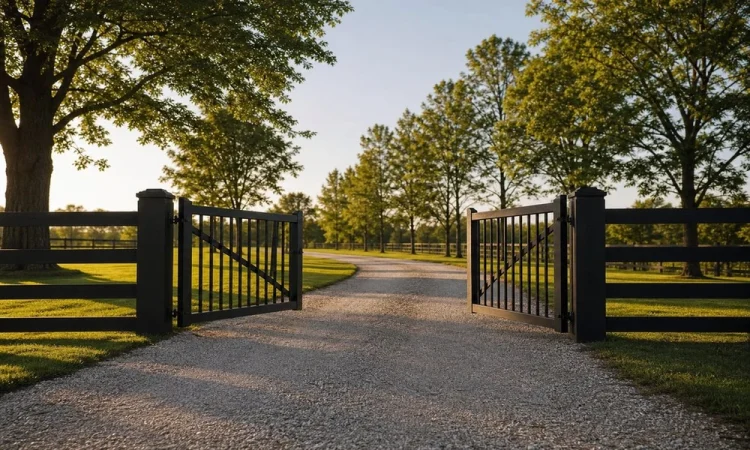
Start by determining the purpose and frequency of use, types of users, and vehicles or equipment that will pass through. A pedestrian gate, vehicle gate, service gate, and emergency access each have different needs.
Define Access Needs Before Choosing a Gate
Some questions to consider include:
- How will the gate be opened (manual, keypad, intercom, remote control)?
- Should privacy from the street be a priority, or should the property be more open and visible?
- Are there special circumstances that might require more than one gate, like separate pedestrian and vehicle entrances, or a separate service entrance for deliveries?
- Are there turning or parking considerations? Can a vehicle enter the property and stop or park without blocking traffic or requiring complicated maneuvers? Can a driver make a U-turn if necessary? How close can a vehicle get to the gate? Depending on the type of traffic expected and the configuration of the driveway, a clear opening of six feet may not be wide enough for vehicle access.
Access requirements also influence the placement of the gate in relationship to the road, the size and proportion of the gate, the spacing of the posts, and the configuration of the fencing on either side.
Coordinate the Gate and Fence From the Start
It’s tempting to approach the design of an entry gate in isolation, focusing on creating a striking first impression. However, a beautiful entry gate paired with a clashing fence line can give the entire installation an add-on look and feel. Beyond the impact on aesthetics, this disconnect can lead to compromised security, awkward traffic patterns, and maintenance headaches.
Rather than think of your entry gate and perimeter fencing as separate elements, take a more holistic approach. Your entry gate and fence should feel like one cohesive system, working together to outline your property and complement your home’s architecture, landscaping, and approach.
Rather than a focus on decoration, think of your entry gate and fencing as ways to mark the entrance to your property, delineate public and private spaces, control access, and extend your property’s architecture to its boundaries.
Repeat Details Without Making Every Section Identical
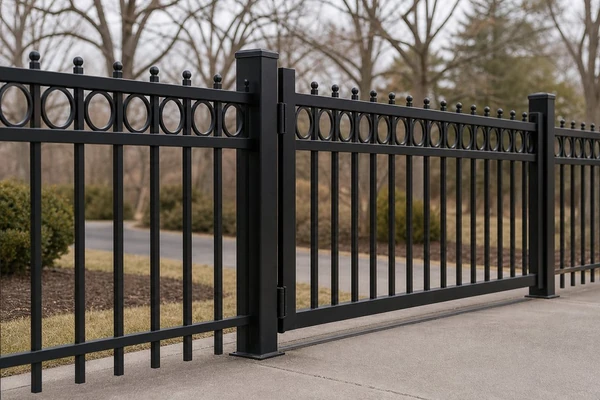
There are a number of ways to create a sense of unity. Repeating elements can create a link between different installations. Picket shapes, rail layouts, finials, and other design features can be repeated in various contexts – from grand entrance gates to pedestrian gates to perimeter fencing to small ancillary fences.
While repetition is one route to cohesion, identical fencing need not be installed throughout the entire property. Instead, certain elements can be repeated at different scales to establish visual connections while creating hierarchy and interest. For example, metal entry gates and fencing lend themselves well to this approach, since the material is versatile and can be specified at a variety of scales. A metal driveway gate might feature more prominent pickets and heavier gauge rails and framing, while the pickets on an adjoining run of fence might be narrower and the rails and framing lighter.
Architectural elements of the home or other outbuildings can also serve as inspiration for an entry gate and fence design. For example, clean lines and minimal detailing may suit a contemporary home, while traditional architecture might call for curved and scrolled elements, ornamental pickets, shaped post collars, and so on. Rather than simply picking a style off the shelf, consider what will suit the property best.
Resolve Structural and Site Constraints Early
Even ornamental metal entry gates and fencing should be structurally sound, and ideally, practical considerations should be worked out before the design process begins. The Queens metal fabrication company European Custom Iron designs estate gates and perimeter fencing around those shared structural requirements. For example, a sliding gate will require a different setup than a swinging gate, and a cantilevered sliding gate will require a different setup than one that rides on a track.
Similarly, make sure there is enough room for the gate to open and close, whether it slides to one side or swings in or out. Don’t overlook landscape elements, walkways, and vehicle traffic as potential sources of interference. European Custom Iron can help ensure your gate design balances aesthetic appeal, structural integrity, and everyday functionality.
Other site and installation considerations might include:
- Uneven grades, plan ahead so that the fencing follows the grade and looks uniform
- Posts set close to the ground, keep fencing adequately spaced away from the soil and pay special attention to setting posts to help avoid water intrusion and rust issues (worth a skim of https://www.nasa.gov/centers-and-facilities/kennedy/corrosion-technology-laboratory)
- Inadequate drainage, standing water can cause rust problems and interfere with the operation of a gate
- Difficult access, make sure that gates open far enough to allow vehicles to pass through
- Service access, ensure easy access to gate and fence components, think latches, hinges, gate operators, etc., to facilitate inspection, maintenance, and repairs
- Repairs, consider the ease of making repairs down the line, and see if any components can be specified to make future repairs easier
- Finishes, factor in the finishes to ensure they’ll complement the structure and landscape; well welded, well sealed metalwork with details that shed water rather than hold it will help prolong the beauty and function of your gates and fencing