Statement Ceiling Fan Installation in Dripping Springs, Texas: Bringing Comfort and Style to Great Rooms With Exposed Beams and High Ceilings
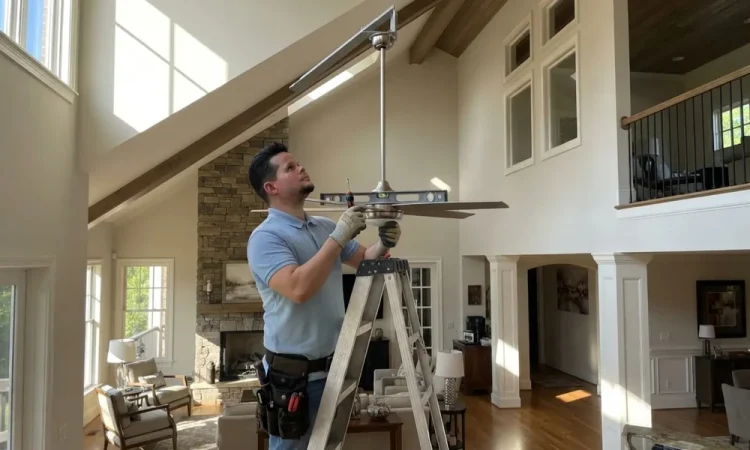
A beautiful great room can make a lasting impression. In many Dripping Springs homes, soaring ceilings, exposed wooden beams, expansive windows, natural stone, and open floor plans create inviting living spaces that reflect the character of the Texas Hill Country. However, these architectural features can also present some challenges when it comes to keeping a large room comfortable throughout the year. One upgrade that can make a noticeable difference is installing an oversized statement ceiling fan that combines practical airflow with attractive design.
From oversized statement fans in custom Hill Country homes to modern ceiling fans mounted on vaulted and cathedral ceilings, Dripping Springs homeowners can turn to Tejas Electric for dependable ceiling fan installation designed around their home’s unique architecture and electrical needs.
Unlike a standard ceiling fan installed in a smaller bedroom, a statement fan in a great room requires careful planning. Ceiling height, room dimensions, mounting locations, existing electrical wiring, structural supports, and surrounding light fixtures all influence the final installation. Choosing the right fan is only part of the process. Making sure it is properly supported, balanced, wired, and positioned is equally important.
For homeowners planning a living room renovation or looking to improve an existing space, understanding these considerations can help create a more comfortable room without compromising its architectural appeal.
1. Choosing Oversized Architectural Ceiling Fans for Hill Country Homes
Many custom homes throughout Dripping Springs feature living rooms with generous ceiling heights and open layouts. A conventional ceiling fan that looks appropriate in a smaller room may appear undersized in a great room with a vaulted ceiling or exposed timber construction.
Oversized architectural ceiling fans offer a practical and visually appealing alternative. Their larger blade spans help circulate air throughout expansive living spaces, while their distinctive designs can become an important part of the room’s overall appearance.
When selecting a statement fan, homeowners should consider several factors:
- Blade diameter: Larger rooms generally require larger fans to move air effectively. The appropriate blade span depends on the room’s square footage, ceiling height, and layout.
- Overall proportions: A fan should complement the scale of the room rather than overwhelm the surrounding architectural details.
- Blade design: Wide, sculpted, or elongated blades can create a dramatic appearance in rooms with high ceilings.
- Finish and materials: Wood tones, matte black finishes, brushed metals, and natural textures can coordinate with existing cabinetry, flooring, and furniture.
- Motor housing: The shape and finish of the motor assembly can influence how the fan looks when viewed from below.
In a Hill Country home with limestone accents, natural wood flooring, and rustic architectural details, a fan with warm wood blades may feel right at home. In a more contemporary property, a streamlined fan with sculptural blades and a clean metal finish might provide a better match.
The goal is to select a fixture that looks intentional within the space while delivering enough airflow for everyday comfort.
2. Installing Wood-Blade, Farmhouse, Industrial, and Contemporary Fan Designs
Statement ceiling fans are available in a wide range of styles, making it easier to coordinate an installation with the personality of a custom home.
Wood-blade ceiling fans are especially attractive in Hill Country interiors. Natural wood finishes can complement exposed beams, timber accents, hardwood floors, and rustic furniture. Some designs feature oversized blades with a slightly distressed appearance, while others use smooth, modern wood finishes for a cleaner aesthetic.
Farmhouse-style fans are another popular option. These fixtures often combine traditional shapes with modern motor technology. Depending on the design, they can work well in homes with shiplap accents, natural finishes, decorative beams, and comfortable, relaxed living spaces.
Industrial ceiling fans offer a different look. Dark metal finishes, substantial motor housings, and simple blade profiles can create a striking contrast against lighter ceilings and natural stone walls. They are particularly well suited to contemporary farmhouse interiors and modern rustic homes.
Contemporary ceiling fans tend to emphasize clean lines, minimal hardware, and streamlined proportions. Some feature curved or sculptural blades that make the fan look more like an architectural design element than a conventional household fixture.
Regardless of the style, homeowners should pay attention to the manufacturer’s installation specifications. Oversized fans can have different mounting requirements, weight ratings, and electrical considerations than standard residential models.
Tejas Electric can help homeowners consider the electrical and installation requirements associated with their selected fixtures before moving forward with a project.
3. Working Around Exposed Wooden Beams and Decorative Ceiling Structures
Exposed wooden beams are among the most recognizable features of many custom Hill Country homes. They add warmth, texture, and architectural interest to a great room. However, they can complicate ceiling fan placement.
A fan cannot simply be attached wherever it looks best. The installation location must provide appropriate structural support and enough clearance for the blades to rotate safely.
For example, a homeowner might want a large wood-blade fan centered between two prominent ceiling beams. While that location may look visually balanced, the electrician must determine whether the intended mounting point has suitable structural support.
Decorative beams can also create challenges when electrical wiring needs to be routed through finished ceiling spaces. Depending on the home’s construction, accessing the necessary wiring may require additional planning.
Before installation, important considerations include:
- Whether the beams are structural or decorative.
- The location of existing ceiling joists or other approved support structures.
- The amount of clearance between the fan blades and nearby beams.
- Whether the mounting location allows the fan to hang level.
- How electrical wiring can reach the fixture without damaging finished surfaces.
- Whether the fan’s mounting hardware is compatible with the ceiling construction.
In some homes, an installation may be straightforward because the ceiling already has an appropriate support location. In others, additional framing or an approved fan-support system may be necessary.
Planning around these details helps preserve the appearance of the ceiling while providing a dependable mounting location.
4. Determining Whether Specialized Mounting Hardware or Structural Reinforcement Is Needed
Large statement ceiling fans can be considerably heavier and more substantial than traditional residential fixtures. Some also have longer blades and different mounting configurations.
This makes the mounting system especially important.
A standard electrical ceiling box is not automatically suitable for supporting a ceiling fan. Fan-rated boxes and support assemblies are designed to handle the weight and movement associated with operating fans. The correct system must also be compatible with the fixture manufacturer’s instructions and the existing ceiling structure.
For homes with vaulted or cathedral ceilings, an extended downrod or specialized angled mounting adapter may be required.
These components help position the fan appropriately when the ceiling slopes or the fixture needs to hang farther below the ceiling.
The installation professional must evaluate:
- The fan’s total weight.
- The manufacturer’s mounting requirements.
- The ceiling’s slope and construction.
- The availability of suitable structural attachment points.
- The required downrod length.
- Blade clearance from walls, beams, and other fixtures.
If the existing framing cannot provide the necessary support, structural reinforcement may be needed before the fan is installed.
This is particularly important in great rooms where a large fixture hangs well above the floor. A poorly supported fan can develop excessive movement, create noise, or become a safety concern.
Homeowners should avoid assuming that a decorative ceiling beam or existing light fixture box can support a heavy statement fan without being evaluated first.
5. Coordinating Ceiling Fans With Recessed Lighting and Architectural Fixtures
A ceiling fan should improve the room without interfering with its lighting design.
Many Dripping Springs great rooms already include multiple lighting elements, such as recessed lights, chandeliers, pendant fixtures, wall sconces, and decorative accent lighting.
Adding a large ceiling fan requires thoughtful coordination so the different fixtures work together.
One common consideration is the relationship between the fan blades and nearby lighting fixtures. If a fan is installed too close to a pendant or chandelier, the moving blades may create distracting visual effects or unwanted shadows.
Recessed lighting also requires consideration. The fan’s position can affect how light is distributed throughout the room, especially when the blades interrupt the light coming from nearby fixtures.
During a renovation, homeowners may want to consider a lighting arrangement that includes:
- Recessed lights positioned to provide balanced general illumination.
- A statement ceiling fan centered within the main seating area.
- Pendant fixtures placed over adjacent spaces or architectural features.
- Accent lighting to highlight exposed beams, stone walls, or built-in shelving.
- Dimmers and compatible controls for adjusting the atmosphere.
The placement of these fixtures should be considered together rather than as separate projects.
Tejas Electric can help homeowners plan the electrical installation so ceiling fans and architectural lighting complement one another while serving their intended purposes.
6. Selecting Quiet, Energy-Efficient Motors for Large Living Spaces
A large ceiling fan should provide comfortable airflow without becoming a distraction.
Motor technology is an important consideration, particularly in great rooms where families spend time watching television, entertaining guests, reading, or relaxing.
Many modern ceiling fans use DC motors, which can offer improved energy efficiency and quieter operation compared with some traditional AC motor designs. However, performance varies by manufacturer and model.
Homeowners should compare more than just the fan’s appearance.
Important specifications include:
Motor efficiency: Look for energy-conscious designs that provide strong airflow without unnecessary electricity consumption.
Airflow performance: Manufacturers commonly publish airflow ratings in cubic feet per minute (CFM). This measurement helps homeowners compare how much air different models move.
Noise levels: A well-designed fan should operate without excessive humming, clicking, or mechanical vibration.
Speed settings: Multiple speed options allow homeowners to adjust airflow depending on the season and room conditions.
Reversible operation: Many ceiling fans include a reverse setting that changes the direction of rotation. This can help redistribute warm air during cooler weather when used appropriately.
In a large living room with high ceilings, the fan’s motor and blade design should be selected based on the size and intended use of the space.
A beautiful fixture that cannot provide adequate airflow will not deliver the comfort homeowners expect.
7. Integrated LED Lighting and Convenient Remote Controls
Modern statement ceiling fans can do more than circulate air. Many models include integrated LED lighting, remote controls, smart-home compatibility, and other convenient features.
Integrated LED lighting is particularly useful when homeowners want a cleaner ceiling appearance without adding another separate fixture.
Depending on the model, LED features may include adjustable brightness, selectable color temperatures, and dimming capabilities.
A warmer light setting can create a comfortable atmosphere for relaxing in the evening, while a brighter setting may be more suitable for everyday activities.
Remote controls are another useful feature, especially when fans are installed in rooms with high ceilings. Rather than relying on a traditional wall switch or pull chain, homeowners can adjust fan speed, lighting, and other settings from a convenient location.
Some models also offer smart-home integration, allowing compatible fans to be controlled through an app or voice assistant.
Before purchasing a fan with these features, homeowners should verify:
- Whether the remote receiver is included.
- Whether the fan requires a particular wall control.
- Whether the LED module is replaceable.
- Whether the fixture supports the desired dimming functions.
- Whether the fan is compatible with existing smart-home equipment.
- Whether additional wiring is necessary for independent fan and light control.
These details are worth addressing before installation rather than discovering compatibility issues after the fixture has been purchased.
8. Evaluating Existing Electrical Wiring and Fan Support Before Installation
One of the most important parts of a statement ceiling fan installation happens before the new fixture is mounted.
The existing electrical system needs to be evaluated to determine whether it can accommodate the selected fan and its features.
For example, a homeowner replacing an older chandelier with a modern ceiling fan may discover that the existing electrical box was never designed to support a moving fixture.
The wiring arrangement may also limit how the fan and lighting functions can be controlled.
Some installations may require additional wiring to provide separate wall controls for the fan motor and integrated light. Other models use remote receivers that simplify certain control arrangements, although compatibility still needs to be verified.
An electrician should evaluate:
- The condition of the existing electrical wiring.
- Whether the circuit and connections are appropriate for the fixture.
- Whether the ceiling box is fan-rated.
- Whether the mounting structure provides adequate support.
- Whether grounding and electrical connections are properly configured.
- Whether additional switches or wiring are needed.
- Whether the installation complies with applicable electrical requirements.
Older homes and properties with previous renovations may have wiring or mounting conditions that are not immediately visible.
Taking time to evaluate these details helps prevent installation problems and supports reliable operation over the long term.
9. Why Ceiling Fan Planning Should Happen Before a Major Living Room Renovation
If homeowners are already planning a major living room renovation, ceiling fan selection should be part of the early design process.
Waiting until the ceiling, beams, drywall, and lighting are finished can make certain installations more complicated and expensive.
For example, a homeowner may select a large architectural fan after the contractor has already completed the ceiling. If the desired mounting location does not have adequate structural support, additional work may be necessary to reinforce the area.
Similarly, installing electrical wiring for a remote-controlled fan, separate lighting controls, or a new ceiling-mounted fixture can be easier while the ceiling is still accessible.
Early coordination allows homeowners, designers, builders, and electricians to work through important decisions together.
A good renovation plan should account for:
- Fan selection: Identify the preferred fixture, blade span, weight, motor type, and lighting features.
- Ceiling structure: Determine the appropriate mounting location and whether reinforcement is needed.
- Electrical planning: Establish wiring routes, switch locations, and control requirements.
- Lighting coordination: Position recessed lights, chandeliers, and other fixtures around the fan.
- Ceiling finishes: Coordinate electrical work with exposed beams, decorative woodwork, and finished surfaces.
- Installation scheduling: Complete necessary electrical and structural preparations before final ceiling finishes whenever practical.
This approach can reduce unnecessary rework and help the finished living room look more cohesive.
For custom homes and substantial remodeling projects throughout Dripping Springs, bringing an electrician into the planning process early can make a meaningful difference.
10. Is Installing an Oversized Ceiling Fan a DIY Project?
For homeowners who enjoy tackling home improvement projects, replacing a basic ceiling fan may seem like a manageable weekend task. However, installing an oversized statement fan in a great room with high ceilings, exposed beams, or vaulted construction is a different situation.
There are important distinctions between assembling a fan and safely installing its electrical and structural mounting system.
A handy homeowner may be comfortable assembling the blades, reviewing the manufacturer’s instructions, or selecting finishes. However, the electrical connections, ceiling support, mounting hardware, and installation at significant heights introduce additional risks.
Oversized fans can weigh considerably more than standard fixtures. They may require specialized mounting hardware, additional structural support, longer downrods, or modifications to existing electrical wiring.
Working from tall ladders or scaffolding also creates safety concerns, particularly when handling a large fixture overhead.
There is also the question of Texas electrical licensing requirements.
Texas regulates electrical contracting and electrical work through the Texas Department of Licensing and Regulation (TDLR). Electrical work that requires a licensed electrician should not be treated as an ordinary DIY project. Homeowners should verify which licensing and permit requirements apply to their particular installation rather than assuming that replacing an existing fixture is automatically exempt.
For installations involving new wiring, circuit modifications, structural fan support, or complicated vaulted-ceiling configurations, hiring a qualified electrical professional is the sensible approach.
Tejas Electric understands the importance of evaluating both the electrical system and the physical mounting requirements before installing a ceiling fan.
Rather than taking chances with an expensive fixture hanging over a family’s primary gathering space, homeowners can have the installation evaluated and completed with the appropriate expertise.
11. Bringing Comfort and Architectural Style to Dripping Springs Great Rooms
A statement ceiling fan can transform the appearance and everyday comfort of a great room.
Whether the home features rustic exposed timber, contemporary architecture, farmhouse finishes, or expansive cathedral ceilings, the right fan can complement the space while helping circulate air throughout the room.
The most successful installations combine thoughtful fixture selection with careful attention to structural support, electrical wiring, lighting placement, and motor performance.
For Dripping Springs homeowners, these details are particularly important because custom Hill Country homes often feature ceiling designs and architectural elements that require more planning than a typical residential installation.
A large fan should not simply look impressive from the living room floor. It should also be appropriately supported, correctly installed, and suited to the room’s dimensions and electrical requirements.
Working with an experienced electrical contractor can help homeowners address these considerations before installation begins.
Make Your Great Room More Comfortable With Professional Ceiling Fan Installation
From oversized wood-blade fixtures to modern architectural fans with integrated LED lighting, the right ceiling fan can become both a functional upgrade and an attractive centerpiece in a custom Hill Country home.
However, installing these fixtures requires more than choosing a design that looks good. Proper mounting support, electrical connections, ceiling height, blade clearance, and lighting coordination all contribute to a successful project.
Tejas Electric provides electrical services for homeowners in Dripping Springs and surrounding Hill Country communities. Whether you are updating an existing living room, building a custom home, or coordinating a major renovation, having the electrical requirements evaluated before installation can help avoid unnecessary complications.
If you are considering a statement ceiling fan for your great room, contact Tejas Electric to discuss your project and explore an installation approach that complements your home’s architecture, electrical system, and comfort needs.
A thoughtfully selected and professionally installed ceiling fan can help make your great room an even more inviting place to gather, relax, and enjoy everything your Hill Country home has to offer.