Concrete gets sold to homeowners as the material that lasts forever. So the first crack across a driveway or patio can feel like a broken promise. The truth is that concrete is expected to crack. It shrinks as it dries, it moves with heat and cold, and it sits on soil that shifts with water. Good flatwork was never meant to have zero cracks. It was meant to crack where it was planned to, and to keep those cracks small.
That way of looking at it matters once you’re deciding what to do. A hairline crack in a ten-year-old driveway and a split near a downspout that keeps getting wider and lower can look alike from the street. They need very different fixes. Experienced contractors such as KISSconcrete Inc. usually look at the ground under the slab before the surface on top. If the base is stable, the concrete can often be repaired instead of torn out. Whether the soil underneath is still holding the slab up settles most of the cost.
The industry’s own guidance points the same way. The National Ready Mixed Concrete Association lists poor subgrade preparation, extra water added to the mix, missing joints and skipped curing among the main causes in its guide to cracking concrete surfaces. Almost all of those problems start on the day of the pour, long before anyone sees a crack.
Shrinkage Is the Crack You Were Promised
Fresh concrete has more water in it than the cement needs to harden. As that extra water leaves, the slab shrinks a little. A slab that can’t shrink freely builds up tension, and it releases that tension by cracking.
Control joints are how installers decide where that happens. These are the grooves cut or tooled into the surface at regular intervals. Each one makes a weak line, so when the slab cracks, it cracks inside the groove where you can barely see it. The association’s guidance on joints in slabs on grade puts the spacing at about 24 to 36 times the slab’s thickness. For a typical 4 inch patio, that’s roughly every 10 feet, and never more than 15. The grooves should go at least a quarter of the way through the slab, and the panels should be close to square.
When you see a straight crack running neatly along a joint, the system did its job. When cracks wander across the middle of panels, the joints were probably too far apart, too shallow or cut too late.
Reading the Line in Front of You
Before you call anyone, spend a few minutes looking at what the crack is actually doing. Its pattern and behavior tell you a lot.
- Thin, random hairline cracks that stay narrower than a credit card’s edge are usually drying shrinkage. They’re mostly cosmetic.
- Fine spiderweb lines across the surface (called crazing) usually come from overworking the surface while finishing or from it drying too fast. They’re only skin deep.
- Short parallel cracks that showed up within hours of the pour are plastic shrinkage. They’re typical of hot, dry or windy pour days.
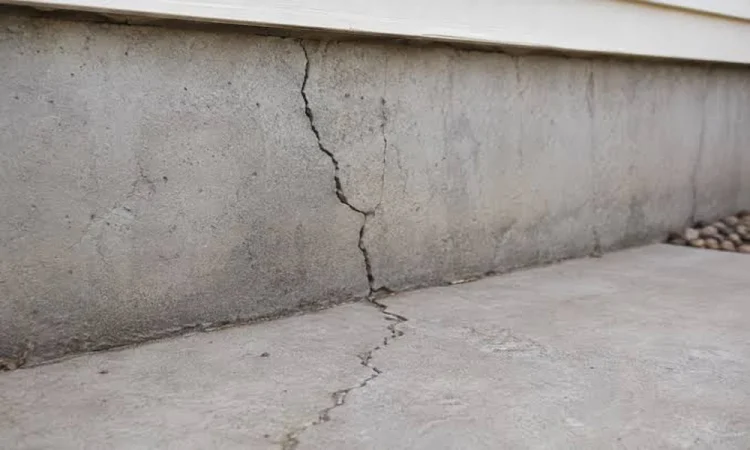
- Cracks where one side sits higher than the other mean the slab is settling, being lifted by roots or moving with the soil.
- Cracks that grow wider month after month mean the cause is still active. Sealing them won’t stop the movement.
- Cracks running out from inside corners, like where a walkway meets a step, often mean a joint was missing at that stress point.
A simple tracking test turns a guess into evidence. Mark both ends of a crack with a pencil and write the date beside it. Then take a photo with a coin next to it for scale. Check again after a season of heat or heavy rain. A crack that hasn’t changed tells a much calmer story than one that has moved past your marks.
Heat, Water and the Ground Below
Climate shapes how concrete behaves long after the truck leaves. In hot, dry places, the surface can dry faster than the concrete underneath it, which leads to the early shrinkage cracks described above. Crews in those conditions often pour early in the morning, put up windbreaks, and mist or cover the slab so it doesn’t dry out too fast.
Water does more long-term damage than heat. Clay soils swell when they’re wet and shrink back as they dry, so they push up on a slab and then let it drop. Downspouts that empty right at the edge of a slab, sprinklers that keep hitting the same corner, and low spots where puddles sit all soften the base over time. A driveway that sinks near the garage often has a drainage problem, not a concrete problem.
Tree roots work more slowly but are just as stubborn. A slab lifted by a growing root usually breaks with a clear ridge and an uneven edge. That’s a trip hazard that needs attention even if the concrete itself is still sound.
When Repair Makes Sense
If the base is holding and the crack isn’t moving, repair is often the smarter spend. Narrow cracks can be cleaned out, widened slightly and filled with a flexible sealant. The sealant keeps water from getting under the slab, and that protects the base more than it improves the look.
Sections that have dropped but are still in one piece can often be lifted back into place. The older method pumps a cement slurry underneath, a process called mudjacking. Newer methods inject expanding foam through smaller holes. Both work best when the slab is mostly intact and the reason it sank has been fixed.
Surfaces that are worn, flaking or crazed can sometimes be resurfaced with a thin overlay. That works only when the slab underneath is stable. Over a base that’s still moving, the old cracks come back through the new surface within a season or two.
When Starting Over Is the Honest Answer
Some slabs are past saving. Several sunken panels, cracks spreading in many directions from one area, soil washed out from under the edges, and surfaces breaking up everywhere all point to a base that has failed. Putting a new surface on top of a failed base just postpones the same bill.
The upside of replacing is that it lets you fix whatever went wrong the first time. A well-compacted gravel base, the right thickness for the load, joints cut the same day or the next morning, and no extra water added at the truck all make a difference. Curing matters as much as the pour. Keeping the slab damp or covered for about a week lets it build strength steadily instead of drying out from the top down. Most new driveways need about a week before they can take vehicle traffic, even though they keep getting stronger for about a month.
Concrete isn’t silent about its condition. Its cracks show what went on during the pour and what’s going on underneath it now. Homeowners who learn to tell a harmless shrinkage line from a crack that’s still moving can skip a lot of unnecessary replacement work. They can also catch the problems that really do need attention before a small repair turns into a full tear-out.